
Meet a Member: Jamila Perry Harley, American Speech-Language-Hearing Association
 By Kathryn Deen, PAR
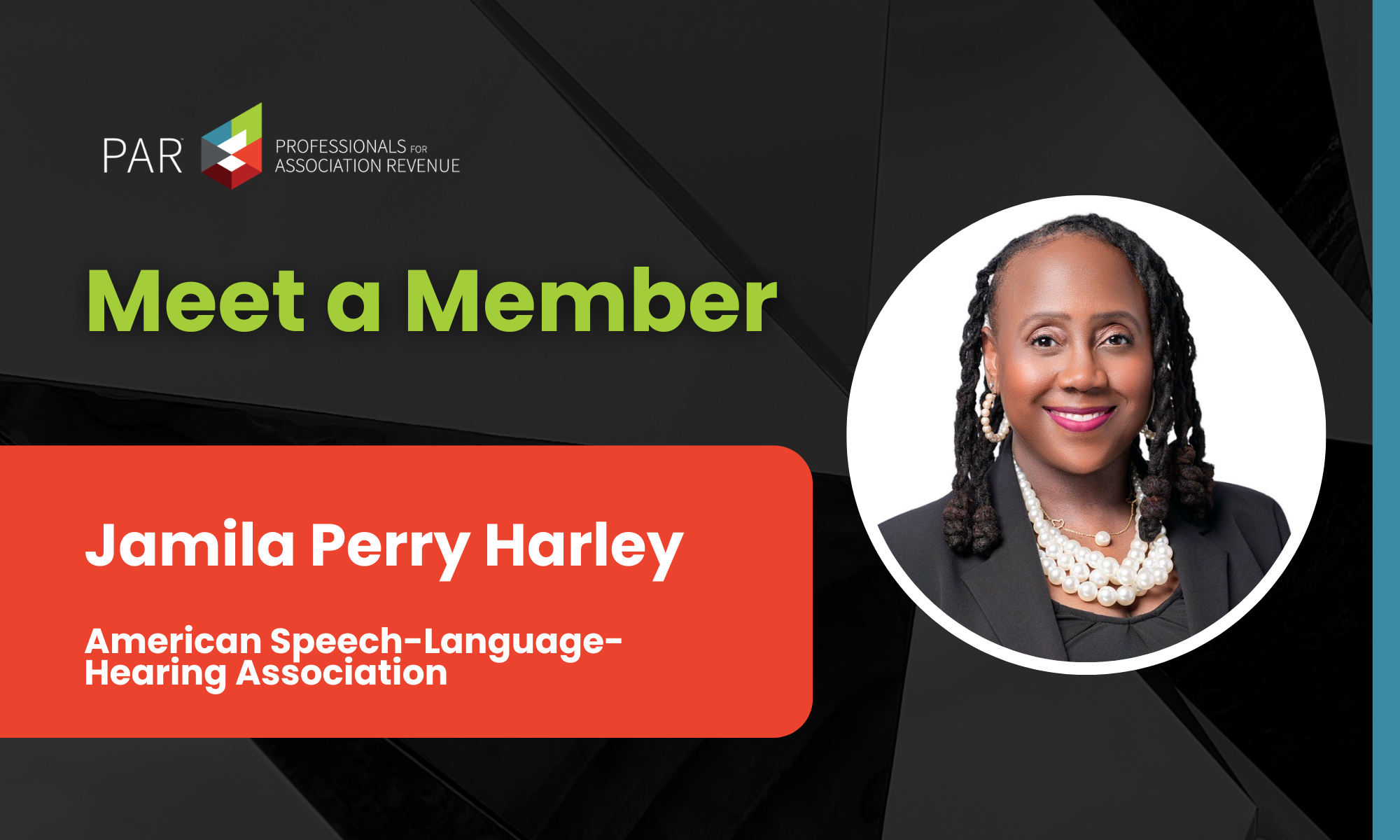
Jamila Perry Harley, MEd, CCC-SLP, CAE, is the director of career management services for the American Speech-Language-Hearing Association. She joined PAR in 2024 and is a member of PAR’s 2026 Business Development Leadership Accelerator Group. Here, she shares how her new speaker series will benefit members and sponsors, why innovation must be grounded in relationships, and what has sustained ASHA for over a century.
Burning Questions
PAR: What’s a recent project or initiative you're especially proud of?
Perry Harley: One of the initiatives I’m most proud of is launching the Career Pivot Speaker Series, which begins this July. It grew out of a simple insight: Career change is deeply personal, yet many professionals experience it in isolation. While our Career Transitions Mentorship Program provides one‑to‑one, peer‑driven support, I saw an opportunity to extend that impact by elevating real stories from members who have successfully pivoted and are willing to share what worked, what didn’t, and what they wish they had known sooner.
The speaker series is intentionally designed to do more than inspire. It elevates members as thought leaders and strengthens the value of association membership. It also offers a mission‑aligned approach to generate non‑dues revenue through recruitment advertiser sponsorship. This is particularly important at a time when traditional recruitment advertising is softening, and employers are looking for more authentic ways to connect with an increasingly passive and discerning job seeker.
Across industries, we are seeing a broader shift. Transactional advertising alone no longer resonates. Employers want credibility and context, and they want to build trust. By centering career development content and lived experience, the Career Pivot Speaker Series creates an environment where sponsors and advertisers can engage in ways that feel relevant and human.
The lesson for me as a business development leader is clear: Engagement drives revenue, not the other way around. When members feel seen, heard, and invested in, they become more open to learning, opportunity, and the partners who support that ecosystem. This initiative reflects my commitment to adaptability, innovation, and building long‑term value for members, advertisers, and the organization.
PAR: What’s in your secret sauce for success?
Perry Harley: If I had to distill my secret sauce down to one principle, it would be this: Innovation only works when it is grounded in real relationships. I’ve learned that pursuing new ideas without staying closely connected to the people you serve may create short‑term momentum, but it rarely leads to lasting engagement.
In my current role, success comes from continually innovating while staying in active conversation with members and advertisers. Today’s members are more informed, more vocal, and more values‑driven than ever. They expect transparency and authenticity not only in programming but in how associations generate revenue and make decisions.
Rather than viewing increased scrutiny as resistance, I see it as an opportunity to strengthen trust. Members want to understand the reasoning behind decisions and to feel included in the process. One of the most important lessons I’ve learned is that inviting feedback early and listening objectively, builds alignment rather than friction.
At the same time, associations have fiduciary responsibilities that require balance. The work is not choosing mission over sustainability but holding both together. The same is true for advertiser relationships. As audiences become more passive, transactional approaches lose effectiveness. Sustainable results come from relevance, credibility, and connection.
Rapid-Fire Q&A
Get to know Perry Harley better with these quick-hitting questions and answers.

What your job entails?
Developing career development content and generating non-dues revenue through recruitment advertising.
Favorite thing about working in associations?
Advancing missions I believe in and helping members achieve goals.
Something about yourself that your colleagues don’t know?
I love the arts, especially musicals, street art, and photography.
Mantra, motto, or favorite quote?
Lift while you climb.
Best advice for a new association professional?
Get connected with other association professionals as peers or mentees.
Best advice for a seasoned association professional?
Mentor, be open to change, never stop learning.
What you would do for your association with a bigger budget?
Hire more staff, invest in more technology.
Favorite use of AI?
To refine and revise written communications.
Favorite experience with PAR?
Participating in the Business Development Leadership Accelerator Group this year.
What you get out of PAR?
A community of peers who are business development leaders and innovators.
My approach is rooted in curiosity, adaptability, and respect. When leaders stay engaged and lead with intention, innovation stops feeling risky and starts becoming a shared outcome.
PAR: What is your association’s revenue superpower?
Perry Harley: I believe our association’s revenue superpower lies in its ability to align business strategy with purpose over time. ASHA is a centennial organization with a large and diverse membership, and that longevity matters. It reflects decades of delivering value, supporting professionals, and evolving alongside the fields we serve.
Longevity, however, does not mean standing still. Like many associations today, ASHA is operating in a moment that calls for thoughtful listening, adaptation, and recalibration as member expectations and partner needs continue to evolve.
What has sustained ASHA is a shared understanding that revenue is not an end in itself. Every revenue stream, whether continuing education, conferences, publications, sponsorships, or recruitment advertising, is intended to support the mission and our members. Business development plays an essential enabling role in that work. It turns intention into infrastructure and allows continued investment in programs and services members rely on.
One insight that has stayed with me is that mission defines why an organization exists, but business development determines how far that mission can reach and how long it can endure. When revenue strategy is approached responsibly, transparently, and with member value at the center, it becomes a stabilizing force.
From my vantage point, ASHA’s strength lies in respecting its history while remaining forward‑looking — not by chasing every new idea but by grounding growth in relevance, stewardship, and long‑term sustainability. That balance between mission and execution is what allows impact to continue even during moments of transition.